
• Short guides to forum navigation, searching, posting, translation, alerts and notifications viewable by clicking here.
  • Türk dostlarımıza hoş geldiniz Giriş burada.
  • Scammers are running ads on Facebook and Instagram claiming a giveaway. DO NOT OPEN THESE LINKS AND LOG IN. See this thread: here
  • The Kinesis Community Forum will be down starting on Friday, Eastern Standard Time, and is expected to be back online on Monday. Big changes in the backend are coming!

The Kinesis blockchain

I've included some general info below, as well as some (fairly dated now) Kinesis documents.

How does a blockchain work?

(The principles in here are good. Proof of work and 10 minute blocks are relevant to Bitcoin but not to the Stellar/Kinesis blockchains. Consensus is also different.)​
Kinesis blockchain
Why the Kinesis Blockchain Network is forked from Stellar:
An Insight into The Kinesis Blockchain:
(Kinesis Blockchain Network and Kinesis Currency Network Security sections are the relevant sections)​
Stellar and Kinesis consensus protocol
How the Stellar Consensus Model Works:


The Consensus Model and Trusted Notes in the Kinesis Blockchain Network:
Kinesis Blockchain Network leverages Cloud Technology to its full advantage:


Note that the Kinesis blockchains for KAU and KAG have been updated fairly recently.
This means that they incorporate the more up to date Stellar features.
  • KAG network upgrade 9th July 2022
  • KAU network upgrade 16th July 2022
 
In the following text
wallet is one of the following
  • integrated wallet - accessed from the WALLET tab in the web application
  • standalone wallet - accessed from wallet.kinesis.money
  • hardware wallet - CoolWallet is the only current instance of this

account is your KAU/KAG account accessed via your Kinesis Money login.

The explanations below may be helpful when trying to follow transactions via the Kinesis Explorer.
Transactions sent wallet to wallet will show as a single transaction with the sending wallet and the receiving wallet included in the transaction.
You can also see the balance of these wallets.

Transactions that involve an account are handled slightly differently.
If some KAU/KAG is sent to an account, it first generates a transaction to that account's deposit address.
It's arrival triggers a second transaction which transfers the KAU/KAG to the Kinesis central Exchange account.
On the blockchain, the balance of the account's deposit address will generally therefore be shown as zero.
The balances of each account are maintained on a separate database.
This is not unusual for exchange accounts from other providers.
This does have some privacy advantages which merit sending/receiving all transfers from accounts rather than wallets, with transfers to/from your own wallet only being done from/to your own account.

If a transaction is sent from an account, then on the blockchain it will show as a transfer from the central Exchange address to whatever target address.
If the target address is another account, then two transactions will be generated.
Firstly to the deposit address of the recipient and secondly from there back to the central Exchange address.

A similar process is followed for BTC, ETH etc.
XRP and XLM are exceptions to this as there is only one transaction which goes directly to the central Exchange address for XRP or XLM, with the tag/memo being used to identify which account should be credited in the database.
 
The above info can be useful when looking for verification of a deposit.
eg if you've made a BTC deposit, then as well as looking for confirmation of the transaction to your account deposit address, you'll need to look for the onward transaction from there to the Kinesis central Exchange account for BTC.
 
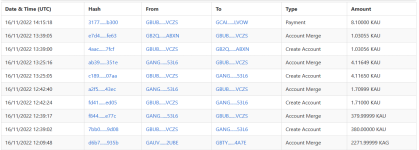
The Type field in the Explorer
When a transfer is made to an address that already exists, it will show up as Payment.
If the address that doesn't exist, it will show up as Create Account.

With reference to my post #2, a transfer to an account will show two transactions:
The first to the account deposit address - this will always be a Create Account.
The second being the onward transfer to the Kinesis central Exchange address - Account Merge.

The Account Merge transaction transfers the balance to the Kinesis central Exchange address and deletes the account deposit address. This is the reason why further transfers to the account always perform the Create Account action.
 
Nodes/Servers
While I don't have any specific details, my understanding is that the blockchain nodes are more diversified than outlined in the original documents linked in post #1.
This also applies to servers used for the database/applications.
 
Hi Uchiki,

Sorry for all the questions, but I have never had the incentive to scrutinise my own understanding of blockchain technologies until now, now that I am trying to rely on it for holding my physical metal account balances. What is/are the protocol/s by which the Blockchain nodes communicate with each other is it TCP/IP or some other encrypted direct address to address communication, or is it not encrypted traffic and thats why it's transactions are visible/searchable and the complex nature of the addresses themselves are what provide the encrypted nature of the transactions. I am sure I can probably try to find this out else ware online but seeing as you are so helpful and responsive thought I would pose the question to you.

Just trying to resolve the thought in my mind that some event may be able to break communications between nodes
 
Just trying to resolve the thought in my mind that some event may be able to break communications between nodes
Uchiki will give a more thought-out and in-depth reply - I tried to write out something lengthy here and decided I was just sidetracking the issue.

As I conceptualize it your KAU and KAG (or any assets on a distributed ledger) live as an entry on an immutable ledger where your account number is credited with whatever assets you own. So if we check this entry in the Kinesis explorer we can see that account GBUB...SVCZS has 539858.7141605 KAU in it.

In order to send from that account from another account, someone needs to create a message requesting the transfer from that source account to some destination account, sign it with the private key associated with the sending account, and send that message to the servers responsible for maintaining the blockchain. Their job is to check whether the message is valid, which includes verifying the message was signed by the key that corresponds with the account authorizing the send, verify that its sister nodes also concur that the message is valid, and if so enter it on the blockchain.

So if you block communication between nodes it's a denial of service attack - no new blocks can be added to the distributed ledger. I think you're actually more worried about attacks that might result in unauthorized sending of assets from one wallet to another.
 
Hi Derek,
Thanks for your reply, it is the denial of service that interests me the most at this current time, but I appreciate your explanation of the process
 
Hi Derek,
Thanks for your reply, it is the denial of service that interests me the most at this current time, but I appreciate your explanation of the process
In that case, assuming all the nodes are on the AWS system, they should have a private communication channel between them. I do "real" servers and virtual machine workloads and I've never really mastered the Amazon and Google cloud offerings, but I have a difficult time imagining a bunch of virtualized machines not sharing a network connection that's private amongst themselves.

Again, I have no information here, but it's a reasonable base assumption.

Uchiki - is there someone we can ask?
 
Hi Uchiki,

Sorry for all the questions, but I have never had the incentive to scrutinise my own understanding of blockchain technologies until now, now that I am trying to rely on it for holding my physical metal account balances. What is/are the protocol/s by which the Blockchain nodes communicate with each other is it TCP/IP or some other encrypted direct address to address communication, or is it not encrypted traffic and thats why it's transactions are visible/searchable and the complex nature of the addresses themselves are what provide the encrypted nature of the transactions. I am sure I can probably try to find this out else ware online but seeing as you are so helpful and responsive thought I would pose the question to you.

Just trying to resolve the thought in my mind that some event may be able to break communications between nodes
Hi @rightone72

just thought I would share a few pointers with you...

1) the kinesis blockchain network (KBN) is, as you probably already aware, a fork of the stellar network
2) nodes on the stellar network use a program called the Stellar Core - which is the Stellar Consensus Protocol (SCP) - a construction of the Federated Byzantine Agreement (FBA).
3) FBA differs from other consensus mechanisms like PoW and PoS by relying on the agreement of trusted nodes.
4) Stellar Core connects to a peer-to-peer network to keep the ledger in sync.
5) To enable this the nodes needs to maintain specific TCP ports available for inbound and outbound communication.
6) As the KBN is a fork of the stellar network then I would assume the same governing rules apply
7) As you will be aware, Kinesis is hosted by AWS and Kinesis 'makes full use of their security services'.
8) I am aware from AWS literature that they have a managed DDoS protection service (AWS Shield) that is available in all AWS regions and services. It stands to reason that Kinesis will be fully utilising this and that, as a DDoS attack is far more substantive, the AWS Shield would also protect from a DoS attack.

Hope this helps some...
 
Last edited:
Dodging the Sleet and Freezing rain this Holiday, I came across an article on the Twitterverse comparing three Gold backed digital currencies, PAXG, TETHERG and Kinesis. This was a relatively critical analysis of all three, with seemingly particular scrutiny of KMS. Leaving speculation of the Author’s intent aside, there was one claim made that I had never contemplated, and hope to gain some clarity here on a Platform I trust . How can one determine on the Kinesis Blockchain Explorer the number of circulating Kau/Kag in existance at that moment, and what “wallets” they are contained in.

This seems a foundation piece of blockchain verification / digitalization of assets. Sorry is this redundent to most of y’all, but I’m old, largely void of computer saviness, and have only rudimentary if not infantile blockchain knowledge.. (I have reviewed the vids above Uchiki, Thanx for posting, very helpfull !)
 
How can one determine on the Kinesis Blockchain Explorer the number of circulating Kau/Kag in existance at that moment, and what “wallets” they are contained in.
That's probably something we should try to answer with an article. I don't know, to be honest - I log in to the KMS and check the circulation number there (~ 1.22 million KAU and 2.95 million KAG currently). It's not precise, but it's generally been good enough for my use.

I think I saw a link to that article as well. It struck me as a "yeah, but it's not perfect, like look at how much easier it is to use tools developed for the ETH blockchain than it is to use explorer.kinesis.money, and what's that excuse about 'Covid' and 'Audits"" about?" It didn't strike me as legitimate criticism, but any criticism bordering on legitimate ought to be addressed, if for no other reason than that it's good for marketing and people's comfort levels.
 
In the backdrop of recent events with various Exchanges, Scrutiny of Business Practices seems prudent for any Investor. My question seems straight forward enough, and I have to believe that reliance on a "Meter" on a dashboard, with no verifiable detail to support it's claim, will not meet serious institutional investment criteria that everyone pines for to create the velocity to drive the system. Looking forward to @ctharvey and @saha_wirdi take on this.
 
Here's the outline
  • Minting adds KAU and KAG to the KMS.
  • Redemption removes it.
Calculate the two figures and take total Redemptions away from total Mintings and you have the respective circulations.

TBH, I doubt if this is that complex an issue for someone able to code around the Stellar blockchain. Stellar is established tech so an organisation that wanted to look into this shouldn't have a problem. I'm sure any potential partner would be provided with whatever assistance they needed.

FWIW, my understanding is that work is ongoing to enhance the Explorer. I don't know what features are being built in, but these enhancements may help those who don't get down to the code level.
In the meantime, we have the meter on the dashboard.
 
My question seems straight forward enough, and I have to believe that reliance on a "Meter" on a dashboard, with no verifiable detail to support it's claim, will not meet serious institutional investment criteria that everyone pines for to create the velocity to drive the system.
Well, Kinesis has audits too. So we know that at least 2x every year (4x next year, it seems) every gram of metal on the blockchain was matched by a gram in the vaults.

As I understand it none of their competition is doing proper 3rd party audits.
 
Can the velocity/fee pool be calculated by looking at the blockchain? If not, would it be technically and operationally possible to get there? My current understanding is that the token supply is fully verifiable but the fees/velocity are not.

My understanding of how the Kinesis Exchange integrates with the blockchain is poor at best. 🤔 From my reading it seems to be represented by a single address. I understand that special rules must apply for the Exchange since it is the interface to things that are not on the blockchain (USD, BTC, ...).


Could an address register transactions to itself to generate fee visibility on the blockchain? If so that would be a way that the transparency of the Kinesis Exchange could be increased. Another way could be if the Exchange was represented by two addresses that transacted with each other.

best regards Oskar
 
Here's the outline
  • Minting adds KAU and KAG to the KMS.
  • Redemption removes it.
Calculate the two figures and take total Redemptions away from total Mintings and you have the respective circulations.
Hello {again} Uchiki ... Still Plodding away with my blockchain lessons. I see that the KC Chain Explorer has a new feature at the top of the page.
1.20.23 kce mint redem.JPGDoes Minting and Redemption , in this context, speak of | correlate to the same physical activities happening on the KMS exchange? and are these all time, cumulative events? Presuming So.

That said, what are the other sources of redemption than physically taking possession such as I did with 100 ounces of Ag, and 200G of Au ?
 
all time, cumulative events?
yes
what are the other sources of redemption than physically taking possession such as I did with 100 ounces of Ag, and 200G of Au ?
Some will be physically taking possession.

However, much will currently be market makers redeeming, with I think an expedited route to USD.
This enables them to balance their books.
Minter purchases via Mint, sells via Exchange to market maker.
Market maker has excess of KAU relative to USD, so redeems KAU for metal for USD.

I would expect this to moderate substantially as KVT incentivised minting comes to an end, with minting moving towards a balance with organic demand.
 

Translate

Back
Top