

Introduction
Fees are either generated on or off-chain.
Many fees are generated off-chain.
See also this post which gives a wider view of the sources of fees:
 forum.kinesis.money
This article focuses on the ones that are generated on-chain and particularly where you can see them and how the monthly Inflation event works.
I'll reference Jason's article via quotes and then walk through in detail
forum.kinesis.money
Blockchains and explorers (blockchain viewers)
There is one blockchain for KAU and a separate one for KAG.
Copies of these blockchains exist on multiple nodes, which require to be kept in sync in order to achieve consensus to confirm transactions.
There are also watcher nodes, for which there is a lower performance requirement, but these should normally be in sync with the main nodes. One of these is the community watcher node maintained by Derek.
There are currently two viewers that are readily accessible to anyone for this source data. Other Stellar explorers can also be used and pointed at the KAU or KAG blockchains. However for full functionality eg to download all blockchain operations, this would require technical setup, likely by someone running a watcher node. You can download the full blockchains from Derek's watcher node.
The first viewer is the Kinesis Explorer
 explorer.kinesis.money
The second viewer is a 3rd party explorer set up by Derek on his watcher node
 watcher.aboutkinesis.com
(Use Set Custom Network to switch between KAU and KAG blockchains)
watcher.aboutkinesis.com
(Use Set Custom Network to switch between KAU and KAG blockchains)
Accumulation of on-chain fees
Here's an example:
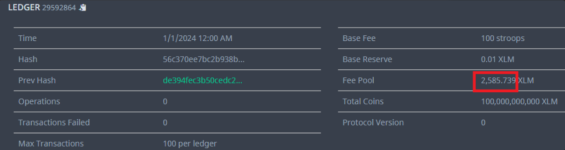
This is for the KAU blockchain.
Bear in mind that this is a 3rd party explorer and assumes that the units recorded in the blockchain are XLM, even though they are actually KAU.
You can see this building up during the month if you query increasing Ledger numbers.
This Fee Pool number is automatically updated by each on-chain transfer, whether it be
Inflation event
If we now look at the next Ledger, we can see that it includes the Inflation event for 1st Jan 2024 and the Fee Pool value has been cleared.
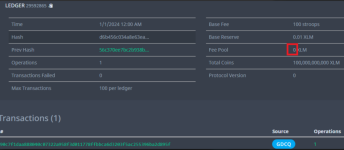
Here's the Inflation event transaction:
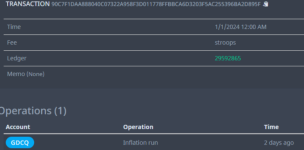
We can see a bit more detail by looking at that transaction via the Kinesis Explorer:
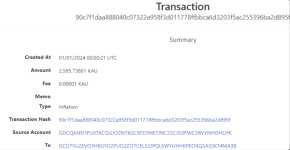
The Inflation operation results in the Fee Pool amount being deposited into the Fee Pool account (GCO75U2EVO3HKGYO2PUO2ZO7CEL52JPQL5WYUHHKPEORQSASSKT4MA3B)
Distribution of Inflation amount
This is subsequently distributed to three accounts.

Transfer to Emission account
When a minting is done, it involves a blockchain transfer from the Emission account.
As in the quote above,
This is done by the block transfer of part of the Inflation amount back to the Emission account.
Transfer to Hot Wallet account
As stated further up, market makers are not subject to fees.
Redemptions involve a blockchain transfer from the Hot Wallet account to the Emission account with automated blockchain fees. These fees need to be "reversed".
This is done by the block transfer of part of the Inflation amount back to the Hot Wallet account.
Transfer to GDVIV.... account
Aside from minting and redemption transactions, there are transfers between the accounts of Kinesis participants.
These may be ad hoc transfers between accounts or those done via Kinesis Pay.
These will generate automated blockchain fees, which need to be transferred to the MFP.
This part of the Inflation amount is paid to the GDVIV... account and becomes part of the MFP.
While this amount is currently modest compared to the minting amount, it should grow significantly as Kinesis Pay is rolled out.
KAG blockchain equivalent accounts
The above walkthrough was done on the KAU blockchain.
For reference, here are the equivalent accounts on the KAG blockchain
Fee Pool
GBBVUAMR3CYNQKMNHVWCMUQVE3XQIL3WM5GSP5D6SCECKIZNNBT6FT7I
This is the account which receives the KAG Inflation amount.
The transfers from the Fee Pool account to this account go into the MFP
GDVIVQWQIOVXP4EWQNLZHEGGLUUQALJ47HSN2MZXCEJKSSH4DBRT5BDM
(same account number as for KAU, but on the KAG blockchain).
Fees are either generated on or off-chain.
Many fees are generated off-chain.
See also this post which gives a wider view of the sources of fees:
What contributes to the yield pool and how does this happen?
Core fee generation Transfers Sends of KAU and KAG from wallets or accounts generate a 0.45% fee. These are on-chain transactions, so will show on the Explorer. Minting Minting transactions are on-chain, so will show on the Explorer. However, the 0.45% minting fee is applied in USD and then...
forum.kinesis.money
This article focuses on the ones that are generated on-chain and particularly where you can see them and how the monthly Inflation event works.
I'll reference Jason's article via quotes and then walk through in detail
Understanding the Kinesis Blockchain
When the concept of the Kinesis Monetary System was originally conceived, Kinesis required a state-of-the-art blockchain that had great community support, was flexible, was low cost to operate and transact upon and was able to support the unique aspects of the Kinesis Monetary System –...
forum.kinesis.money
Blockchains and explorers (blockchain viewers)
There is one blockchain for KAU and a separate one for KAG.
Copies of these blockchains exist on multiple nodes, which require to be kept in sync in order to achieve consensus to confirm transactions.
There are also watcher nodes, for which there is a lower performance requirement, but these should normally be in sync with the main nodes. One of these is the community watcher node maintained by Derek.
There are currently two viewers that are readily accessible to anyone for this source data. Other Stellar explorers can also be used and pointed at the KAU or KAG blockchains. However for full functionality eg to download all blockchain operations, this would require technical setup, likely by someone running a watcher node. You can download the full blockchains from Derek's watcher node.
The first viewer is the Kinesis Explorer
Kinesis Chain Explorer
The second viewer is a 3rd party explorer set up by Derek on his watcher node
Stellar Explorer
Accumulation of on-chain fees
This is not visible in the Kinesis Explorer, but can be viewed via the 3rd party explorer on Derek's watcher node.When transactions are completed on the blockchain, a fee is paid by the sender, which accumulates in the ledger header.
Here's an example:
This is for the KAU blockchain.
Bear in mind that this is a 3rd party explorer and assumes that the units recorded in the blockchain are XLM, even though they are actually KAU.
You can see this building up during the month if you query increasing Ledger numbers.
This Fee Pool number is automatically updated by each on-chain transfer, whether it be
- minting
- redemption
- transfer between two accounts which is neither of the above
- all minting (this is now charged as a $ fee levied at the time of minting - see quote below)
- redemption - any redemptions by market makers are not chargeable. The majority of redemptions are currently by market makers. The fee is chargeable for normal participants taking delivery of bars.
- top up transfers from Root to Emission account (both are outside of the KMS).
These fees are then distributed to participants in the Kinesis ecosystem on a periodic basis (currently monthly) based on their activity. A process occurs each month called ‘inflation’ where the fees from transactions are sent to an account within the KMS to be distributed as a yield.
Some fees that are generated and stored in the ledger header may not be distributed and are returned back to the emission account. Examples include when fees are paid to return coins back to the treasury account as part of a redemption or when fees are paid from the root or emission account usually generated from the emission of new coins.
This is because the minting transaction on the blockchain is an operational transaction to send the coins to the customer and is not intended to generate fees. Any fees related to the minting of the coins would be collected through the mint as outlined below.
Mint application fees
Whenever coins are minted by users through an account on the Kinesis Mint, a USD fee is charged. The USD fees are converted proportionally to KAU and KAG daily and added to the fee pool directly.
Inflation event
If we now look at the next Ledger, we can see that it includes the Inflation event for 1st Jan 2024 and the Fee Pool value has been cleared.
Here's the Inflation event transaction:
We can see a bit more detail by looking at that transaction via the Kinesis Explorer:
The Inflation operation results in the Fee Pool amount being deposited into the Fee Pool account (GCO75U2EVO3HKGYO2PUO2ZO7CEL52JPQL5WYUHHKPEORQSASSKT4MA3B)
Distribution of Inflation amount
This is subsequently distributed to three accounts.
- Emission account (1261.2882 KAU non-chargeable fees)
- Hot Wallet account (1234.35047 reversal of redemption fees)
- Chargeable fees going to an MFP (Master Fee Pool) account, (GDVIVQWQIOVXP4EWQNLZHEGGLUUQALJ47HSN2MZXCEJKSSH4DBRT5BDM), which subsequently gets Account merged into the Hot Wallet account.
Transfer to Emission account
When a minting is done, it involves a blockchain transfer from the Emission account.
As in the quote above,
The automated blockchain fees for the minting transfers are therefore redundant and need to be "reversed".a USD fee is charged. The USD fees are converted proportionally to KAU and KAG daily and added to the fee pool directly.
This is done by the block transfer of part of the Inflation amount back to the Emission account.
Transfer to Hot Wallet account
As stated further up, market makers are not subject to fees.
Redemptions involve a blockchain transfer from the Hot Wallet account to the Emission account with automated blockchain fees. These fees need to be "reversed".
This is done by the block transfer of part of the Inflation amount back to the Hot Wallet account.
Transfer to GDVIV.... account
Aside from minting and redemption transactions, there are transfers between the accounts of Kinesis participants.
These may be ad hoc transfers between accounts or those done via Kinesis Pay.
These will generate automated blockchain fees, which need to be transferred to the MFP.
This part of the Inflation amount is paid to the GDVIV... account and becomes part of the MFP.
While this amount is currently modest compared to the minting amount, it should grow significantly as Kinesis Pay is rolled out.
KAG blockchain equivalent accounts
The above walkthrough was done on the KAU blockchain.
For reference, here are the equivalent accounts on the KAG blockchain
Fee Pool
GBBVUAMR3CYNQKMNHVWCMUQVE3XQIL3WM5GSP5D6SCECKIZNNBT6FT7I
This is the account which receives the KAG Inflation amount.
The transfers from the Fee Pool account to this account go into the MFP
GDVIVQWQIOVXP4EWQNLZHEGGLUUQALJ47HSN2MZXCEJKSSH4DBRT5BDM
(same account number as for KAU, but on the KAG blockchain).