
Overview
Kinesis, like all crypto-related projects, uses something called a distributed ledger (or blockchain). This is a record of transactions going back to the beginning of the system that all the blockchain nodes maintain simultaneously. New transactions are added to the distributed ledger in a way that makes it mathematically impossible to alter previous records, so anyone can look at the ledger and see every transaction that's happened since the beginning and have confidence in the authenticy and accuracy of that record.
It can be more complex than that, but we have a reasonably comprehensive thread digging into these topic here:
To really understand what a hardware wallet does and why you might want one, I think it makes sense to summarize it as follows:
Well, it depends. This is a risk management exercise, and it's up to you to weigh the risks involved. Moving assets to an account that's controlled by a hardware wallet protects from some risks, but exposes you to some others. I suppose it's like keeping 100% of your gold and silver in the Kinesis vault versus storing some locally. If you keep it all in Kinesis then you have counter-party risk (what if something happens to Kinesis), but if you store it locally you're at risk of having it stolen by a burglar.
I think it makes sense to diversify those risks a bit, but others disagree -- after all, in Kinesis the blockchain just controls legal ownership of physical metal we trust Kinesis to vault for us anyway. Strengthening the controls we have on the blockchain still leaves us with a degree of counter-party risk that we can't eliminate. We can reduce it a bit by reading the audits and performing ongoing due diligence in the system, but some degree of risk will always remain.
When your assets are stored on the Kinesis Monetary System (KMS) you can access your account via web site or app, and access to your account is controlled by knowledge of your username/password, and possession of a 2FA device so a hacker needs more than just your username and password to access your account. This means it's difficult for a hacker to gain access to your computer and use that to empty your account, but it's not impossible.
For that reason I have a hardware wallet that I segregate some funds in. I treat this as a savings account and think of my KMS account as a checking account. While I can transfer assets from my offline account to the KMS in less than a minute, should the worst happen and my KMS account become compromised I know the assets protected by my hardware wallet will remain untouched. So funds I'm not planning on spending, and most of my KVTs are in the hardware wallet for an added bit of security.
What hardware wallets are supported?
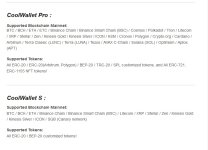
According to Kinesis only the Coolwallet S is supported, but according to the Coolwallet documentation it looks like the Coolwallet Pro supports the Kinesis blockchain as well. KAU and KAG are supported natively, and if you want to add KVT to your wallet that's a contract that can be imported relatively easily as shown in the setup video below.
How does the Coolwallet S work?
This is a device the size and shape of a credit card, and when you want to do something that requires the use of the hardware wallet (like sending funds) you will need to enter the details of the transaction you are creating in the app on your phone, turn on the Coolwallet and allow it to connect to Bluetooth, and manually approve the transaction using a button on the Coolwallet.
This requires:
Hardware Wallet Risks
There are two problems with hardware wallets, both of which are tied to the seed phrase used with the account:
The second risk requires more thought.
Please note: someone simply stealing your hardware wallet does not give them access to your account.
Hardware Wallet Costs
In addition to purchasing the Coolwallet hardware, transfers from one wallet in Kinesis to another wallet cost 0.45%. So if you want to implement a hardware wallet and transfer 100 KAU to it, 99.55 KAU will arrive in your hardware wallet. When you transfer that back to the KMS, that fee will be assessed again, leaving you with 99.1 KAU at the end of the process. KVT transfers consume ETH as a gas fee.
This is the cost of diversification.
What about yields?
Kinesis pays yields on holdings to users who have passed Know Your Customer criteria, and by default Kinesis won't associate a new wallet with your identity. You need to take an extra step so that Kinesis knows that new hardware wallet is yours.
Once the hardware wallet is linked, you will receive holder's yield earned by the assets in the external wallet, but these are always paid to the linked KMS account rather than the external wallet.
Next Steps
Members of the Kinesis Ambassador Community have put together some videos that are worth watching if you're interested in using the Coolwallet:
Kinesis, like all crypto-related projects, uses something called a distributed ledger (or blockchain). This is a record of transactions going back to the beginning of the system that all the blockchain nodes maintain simultaneously. New transactions are added to the distributed ledger in a way that makes it mathematically impossible to alter previous records, so anyone can look at the ledger and see every transaction that's happened since the beginning and have confidence in the authenticy and accuracy of that record.
It can be more complex than that, but we have a reasonably comprehensive thread digging into these topic here:
To really understand what a hardware wallet does and why you might want one, I think it makes sense to summarize it as follows:
- Every account has two keys associated with it that are mathematically derived: a public key and a private key. Anything signed by the private key can be authenticated with the public key, and vice-versa. Knowing one does not allow you to derive the other.
- Your account address on the distributed ledger is your public key.
- If you want to send funds from your account in Kinesis (or on any blockchain-based system) to another account then you need to send a message to the blockchain nodes that is signed by your private key. The nodes can then verify that the message is authentic (signed by your private key, which only you possess) and in response will generate a new block on the blockchain that performs the transfer you requested.
- A hardware wallet simply stores your private key securely, offline, so stealing your assets requires more than hacking / stealing your computer or phone. The attacker would need physical access to the hardware wallet, and would need to know the code to unlock it as well.
Well, it depends. This is a risk management exercise, and it's up to you to weigh the risks involved. Moving assets to an account that's controlled by a hardware wallet protects from some risks, but exposes you to some others. I suppose it's like keeping 100% of your gold and silver in the Kinesis vault versus storing some locally. If you keep it all in Kinesis then you have counter-party risk (what if something happens to Kinesis), but if you store it locally you're at risk of having it stolen by a burglar.
I think it makes sense to diversify those risks a bit, but others disagree -- after all, in Kinesis the blockchain just controls legal ownership of physical metal we trust Kinesis to vault for us anyway. Strengthening the controls we have on the blockchain still leaves us with a degree of counter-party risk that we can't eliminate. We can reduce it a bit by reading the audits and performing ongoing due diligence in the system, but some degree of risk will always remain.
When your assets are stored on the Kinesis Monetary System (KMS) you can access your account via web site or app, and access to your account is controlled by knowledge of your username/password, and possession of a 2FA device so a hacker needs more than just your username and password to access your account. This means it's difficult for a hacker to gain access to your computer and use that to empty your account, but it's not impossible.
For that reason I have a hardware wallet that I segregate some funds in. I treat this as a savings account and think of my KMS account as a checking account. While I can transfer assets from my offline account to the KMS in less than a minute, should the worst happen and my KMS account become compromised I know the assets protected by my hardware wallet will remain untouched. So funds I'm not planning on spending, and most of my KVTs are in the hardware wallet for an added bit of security.
What hardware wallets are supported?
According to Kinesis only the Coolwallet S is supported, but according to the Coolwallet documentation it looks like the Coolwallet Pro supports the Kinesis blockchain as well. KAU and KAG are supported natively, and if you want to add KVT to your wallet that's a contract that can be imported relatively easily as shown in the setup video below.
How does the Coolwallet S work?
This is a device the size and shape of a credit card, and when you want to do something that requires the use of the hardware wallet (like sending funds) you will need to enter the details of the transaction you are creating in the app on your phone, turn on the Coolwallet and allow it to connect to Bluetooth, and manually approve the transaction using a button on the Coolwallet.
This requires:
- You have the Coolwallet application on your phone, configured correctly.
- You know both the phone password and the Coolwallet application password, which are hopefully different.
- You have the Coolwallet itself in your possession, configured with your seed phrase.
- You've linked the Coolwallet to the app on your phone using a process that's difficult to hack/guess.
Hardware Wallet Risks
There are two problems with hardware wallets, both of which are tied to the seed phrase used with the account:
- If you lose access to your seed phrase, you lose access to your account unless you can recover your seed phrase. Since a seed phrase is between 12 and 24 words chosen randomly from a list of 2048 words, in the correct order, the odds of guessing correctly are...not exactly zero, but the odds of all the oxygen molecules in your room randomly accumulating in one corner of the room and suffucating you in your sleep next Tuesday might be higher than the odds of guessing your seed phrase if you devote the rest of your life to it. So it's important to store this in a way that it will survive the predictable catastrophes of life (like fire and floods and forgetfulness and theft.) Remember too: assets stored in Kinesis are part of your estate, and if something happens to you they need to be accessible to your heirs, in a way that they can access them.
- Anyone with access to your seed phrase has control over your account, so you need to be careful how you store this.
The second risk requires more thought.
Please note: someone simply stealing your hardware wallet does not give them access to your account.
Hardware Wallet Costs
In addition to purchasing the Coolwallet hardware, transfers from one wallet in Kinesis to another wallet cost 0.45%. So if you want to implement a hardware wallet and transfer 100 KAU to it, 99.55 KAU will arrive in your hardware wallet. When you transfer that back to the KMS, that fee will be assessed again, leaving you with 99.1 KAU at the end of the process. KVT transfers consume ETH as a gas fee.
This is the cost of diversification.
What about yields?
Kinesis pays yields on holdings to users who have passed Know Your Customer criteria, and by default Kinesis won't associate a new wallet with your identity. You need to take an extra step so that Kinesis knows that new hardware wallet is yours.
Once the hardware wallet is linked, you will receive holder's yield earned by the assets in the external wallet, but these are always paid to the linked KMS account rather than the external wallet.
Next Steps
Members of the Kinesis Ambassador Community have put together some videos that are worth watching if you're interested in using the Coolwallet:
Last edited: